Experience - The Hidden Enemy

When you hear “We think the experience they bring will be great for the group”, it may well be the least understood facet of team performance. Experience in itself is looked at through the lens of the individual who has the experience and not the collective who will have to deal with and integrate the experience. The amount of experience a team has has very little influence on overall performance. While there are some exceptions, generally the teams with higher levels of experience tend to be the lower performing teams. The biggest influence of experience is where that experience has been developed. The NRL (National Rugby League) Penrith Panthers 4-Peat Championship run all started with a very low experienced team and it is a good example of a team without high levels of experience but with the experience they have being developed in a very specific way. Conversely, the most experienced team in the NRL in recent seasons has been the St. George Illawarra Dragons who have consistently been in the bottom half of the competition with an average win percentage of 37% over the last 5 seasons.
This dynamic can be seen by taking a deeper dive into the Super Rugby (Rugby Union) competition and through the lens of Cohesion Analytics. The table below is categorised by the level of Experience and the level of Team Cohesion and shows the corresponding Win% of each category. Experience is a measure of the total amount of professional games the players in the team has started per game and the Team Cohesion is the Cohesion Analytics measure of the level of Shared Understanding (Team Total In-Season Cohesion metric - a measure of team strength. The higher the metric, the more understanding, the greater ability to perform).
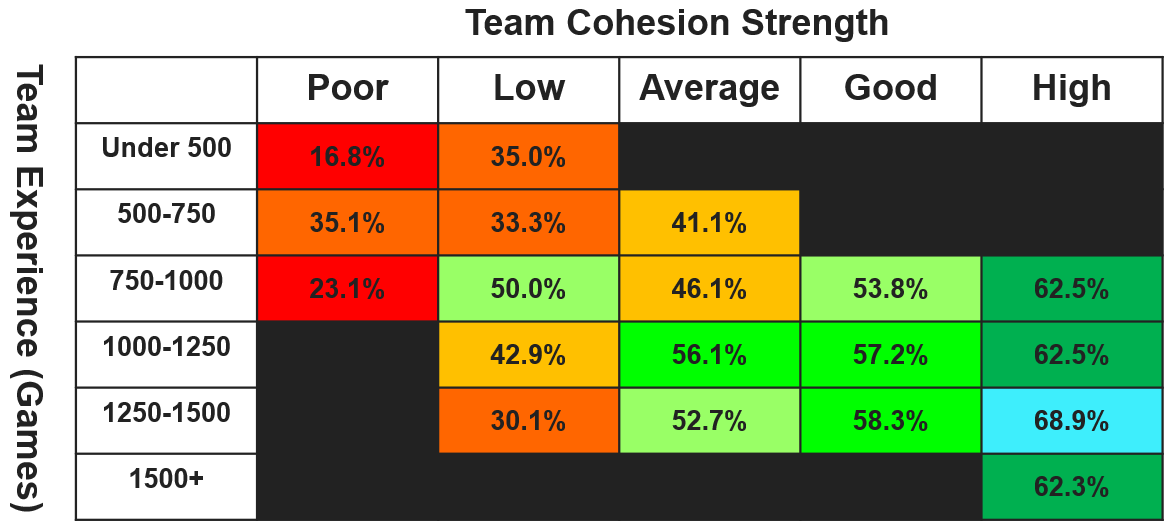
The general trend is that the more Experience and the more Team Cohesion the better the performance. As teams grow Experience and Team Cohesion the performance tends to grow i.e. a better Win%, but there are signals of when too much experience is detrimental to performance.
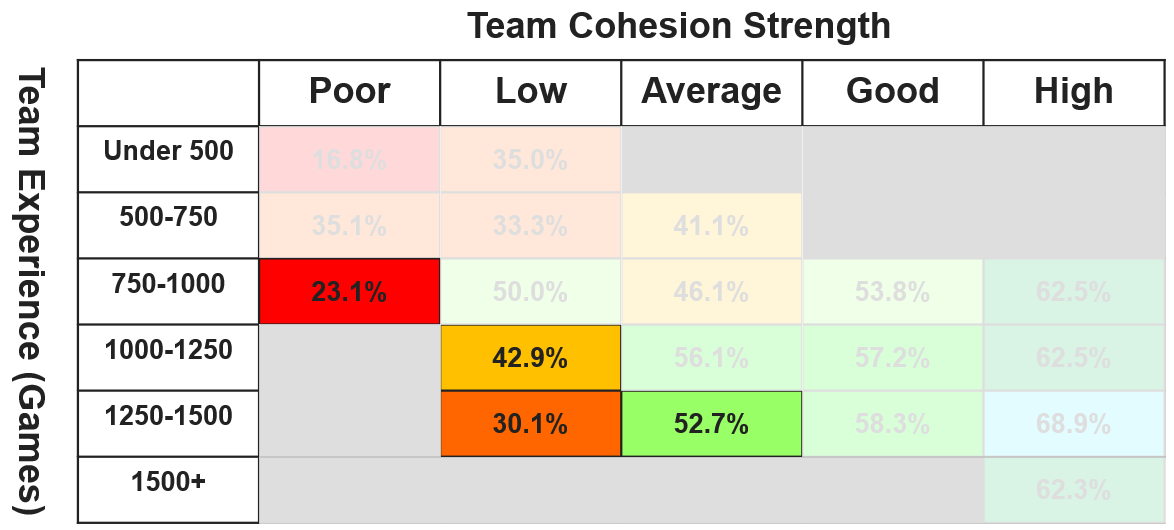
The table below shows the categories where performance reduces. These are the teams that tend to bring in high levels of experience to “top up” their current group. These type of teams are generally low TWI® (TWI® – Cohesion Analytics measure of recruitment practice and indicator of capacity to create in-game Cohesion).
The table below show the categories where performance is consistently positive even with a wide range of experience. The teams in these high performing categories tend to be high TWI®. The most significant difference between a consistently high performing team (and no coincidence being a high Cohesion team) is that the vast majority of the Experience has been developed within that team’s environment.
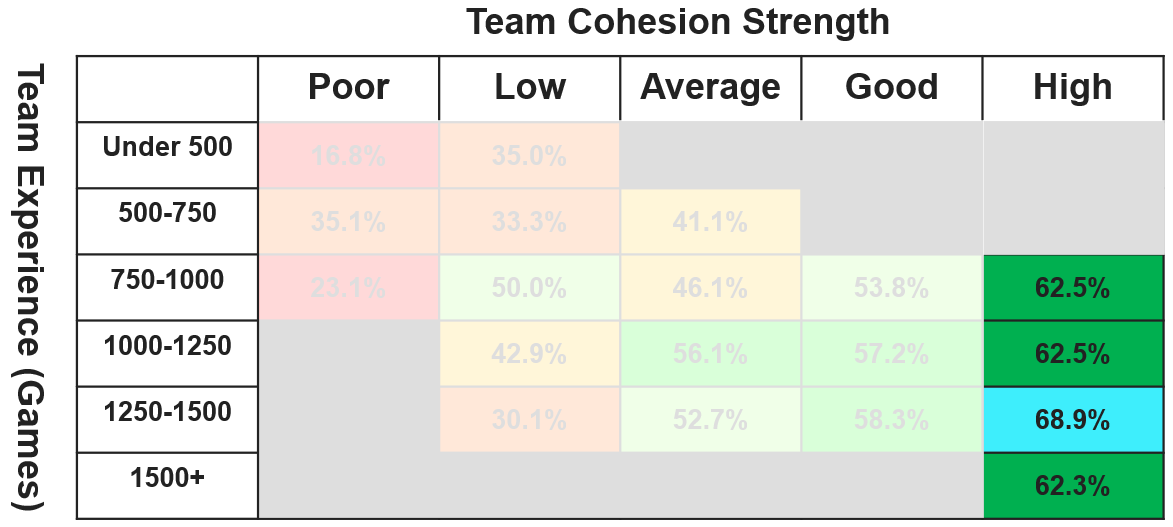
The high TWI® of these teams is a reflection of the recruitment practice focusing on internal development with strong pathways and the ability to maintain their player base. A long-term internal development focus drives shared understanding through what Cohesion Analytics describes as the 3Ps – People/Position/Program. The high normative behaviours created allows players and teams to play to capacity. Conversely, the impact of high levels of external experience (consistent with low TWI® teams) brings in multiple external behaviours and habits making it much harder for a group to get on the same page. In Rugby Union and Rugby League (180 degree invasion sports) this often manifests itself the most in defence with low Cohesion teams generally conceding high levels of points.
Why teams choose to bring in experience differs but in some cases they have no choice. Teams like Moana Pasifika, the Western Force, the now defunct Melbourne Rebels and the Highlanders (to a lesser extent) tend to rely on external experience because the lack of pathway and/or systems that can’t provide the development of experience within their own environments. Other teams bring in external experience driven by a desire for immediate success on the assumption that a players output at their previous club will be replicated. This is often not the case as the ability of a player to perform is driven more by the environment they are in than their individual talent. Either way, it is a function of organisational governance (lack of pathways or a desire to win) than the individual players or on-field staff that ultimately drives the performance outcomes. Many a capable coach has been let go because the system and structure could not create a competitive team.
The high external experience creates low normative behaviours meaning the team has to spend more time developing understanding before developing detailed execution, but also reduces the ability to have any meaningful long-term development cycles because of the age-profiles of players. Teams like these can rarely create meaningful competitive Cohesion before having to “reset” their squads.
All is not lost for those who can’t replicate the refined and aligned systems of teams like the Crusaders, Leinster or the Penrith Panthers. Understanding the levers available can assist in getting the best out of the environment available. The Brumbies are a good example of an organisation who have been able to consistently create strong long-term performance without a big local player base and pathways when compared to the bigger Rugby Union regions within Australia.
Teams don’t need to have “best in class” systems, they just need to have competitive systems in their specific environments. Japan Rugby League One is a good example where teams tend to look for External Experience through the Category C and B player options, but they still need a stable and Cohesive base on which to add those players to. The high TWI® teams in Japan are still the most dominant even if they are not as high as Super Rugby teams.
The challenge for teams who want to move away from a high External Experience group is the path to take. As the top chart shows there is an argument to start from the beginning a grow a group from the top/left to bottom/right. This would give a few seasons of performance “pain” and experience tells us that most organisations can’t seem to take that pain.
Understanding the current state of the group with realistic performance expectations and an aim to create a stable environment is the first step in a systematic transition to becoming more competitive and sustainable.
Simon Strachan / GM of Sport & co-founder
It would be interesting to see a year on year change in outcomes. For example, the lower cohesion higher experience teams may be less successful than others, but are they more successful than their previous performances? I'm thinking of the Dragons on the URC where I think they brought in significant experience last summer and have had a better season (even though they'll miss the playoffs).